
Criminal Cases in Saluda County Courts
Saluda County criminal cases do not all begin or end at one counter. The Court of General Sessions, part of the Eleventh Judicial Circuit, hears felonies and other crimes beyond summary-court jurisdiction. Its case files are kept by the Saluda County Clerk of Court. A bond or initial appearance may occur in summary court before a charge reaches General Sessions, so the first judicial event and the final prosecution can appear in different records.
The Saluda Magistrate Court keeps its own summary criminal and traffic matters. Municipal ordinance, traffic, and permitted summary criminal cases may remain with the issuing town. Saluda Municipal Court participates in the statewide index, but municipal participation is not universal. A searcher should use the court and agency printed on the source paper rather than assume every Saluda County charge belongs to Circuit Court.
Saluda County Criminal Clerk Counter
The Saluda County Clerk of Court is the custodian for General Sessions files at 100 East Church Street, Suite 6, Saluda, SC 29138. The office answers at 864-445-4500 and is open Monday through Friday from 8:30 a.m. to 5 p.m. New filings stop at 4:30 p.m. That cutoff concerns filings; readers seeking an existing file should still call ahead to ask about access, copy fulfillment, and the best arrival time.
The county does not post a current criminal-copy price. Give the clerk a case number and identify the exact docket entry or order. Ask whether an ordinary copy, certified copy, or electronic scan is available and what charge applies. A docket line can prove that a paper was filed without making its image free online. The clerk is therefore the practical second step after any Saluda County court records search.
The official clerk page shows the office and its Public Portal route.
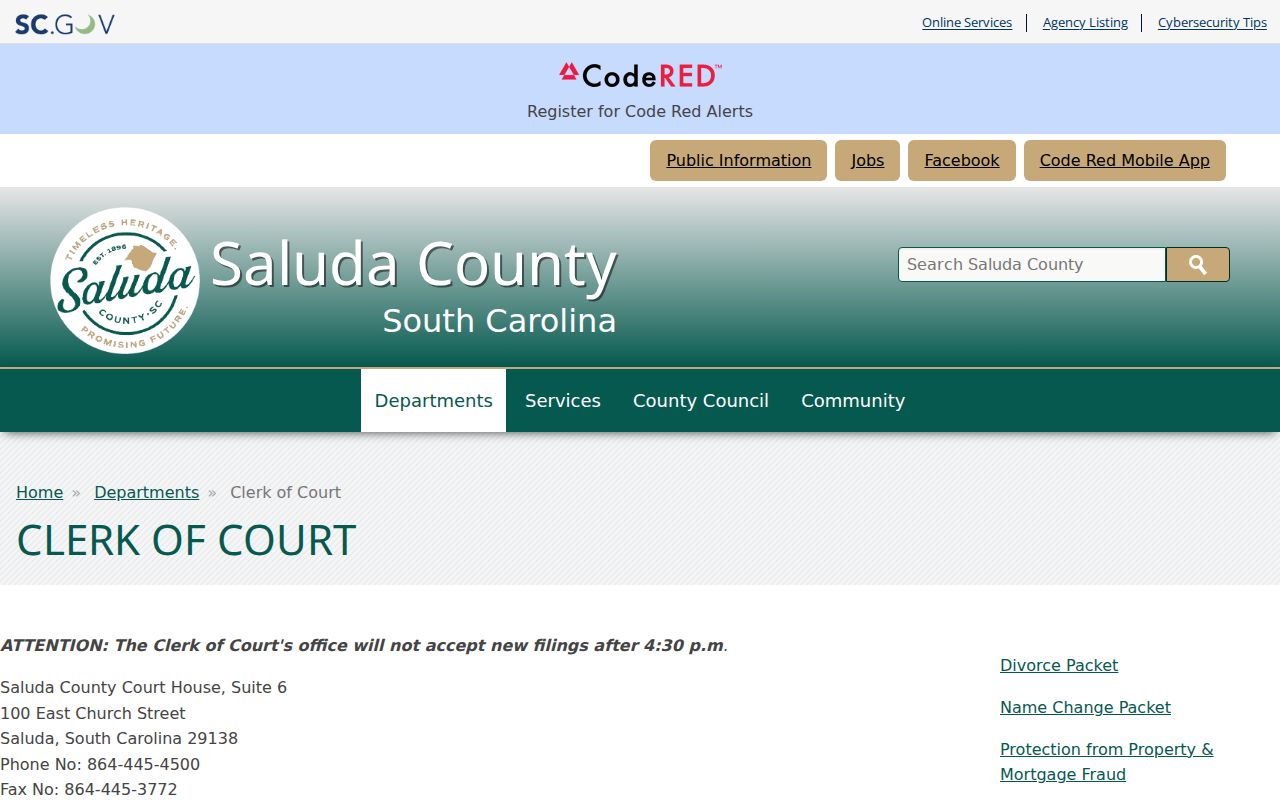
This office page ties the remote docket search to the local custodian who can supply non-imaged or certified Saluda County criminal case documents.
How to Search Case Records
Begin at the South Carolina Judicial Branch Case Records Search, then choose Saluda County and open the Saluda Public Index. The index identifies the jurisdiction as Circuit 11 and County 41. It requires cookies and JavaScript, and a browser may need to permit popups for case detail. Search with few fields first because the interface combines criteria with AND. Too many fields can hide a valid match caused by a spelling, date, or formatting difference.
- Select Saluda County and the relevant court type, then enter the county Public Index.
- Use a known case number first. Otherwise, begin with last name or business name and add first name only as needed.
- Narrow the results by case type, party type, action type, or a filed, disposed, judgment, or arrest date range.
- Open the case number or party link. Compare court, filing date, status, charges, agency, events, and disposition before drawing a conclusion.
- Write down the case number and docket entry, then contact the proper clerk for an unavailable image or certified paper.
The live controls can vary, but the official Public Index guide documents the core fields below.
| Field | Type | Required | Use |
|---|---|---|---|
| Case Number | Text components | For case path | Best route when the full court, year, and sequence are known |
| Last Name or Business | Text | For name path | Supports Begins With or Contains matching |
| First and Middle Name | Text | Optional | Narrows a broad name result |
| Case Type and SubType | Select | Optional | Separates criminal or General Sessions matters from other files |
| Action and Date Type | Select and date | Optional | Narrows by filed, disposed, judgment, or arrest activity |
Saluda County Court Rosters Differ
A roster and a case record answer different questions. The Judicial Branch Court Roster Search helps locate scheduled criminal court activity by county and court. It can show when a Saluda County matter is placed on a session calendar. The Public Index is the better source for the filed case, its event history, status, charges, and outcome. A roster entry does not by itself establish that a hearing occurred or how the judge ruled.
The official court-roster gateway provides the county selector.
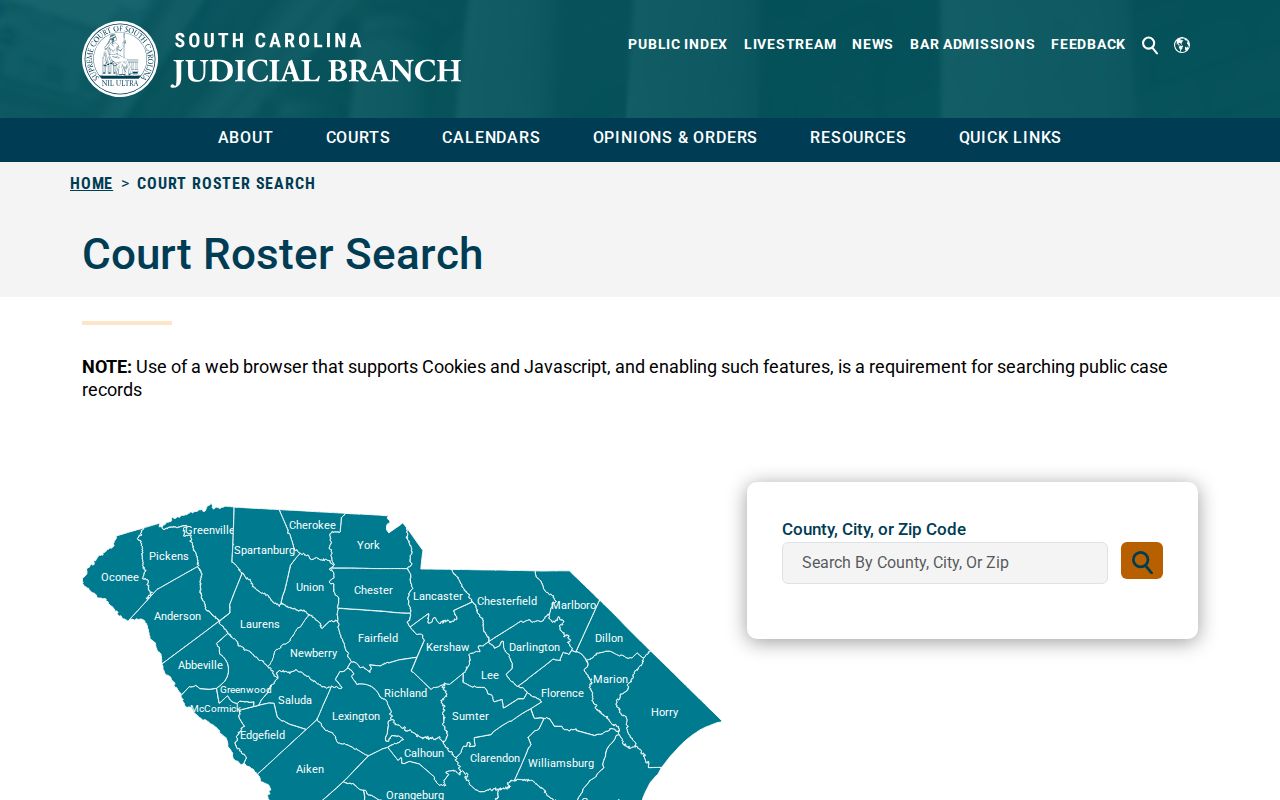
Use the roster to plan around a listed session, then return to the Saluda County docket for events entered after that session.
Note: A calendar setting is not a disposition; confirm the filed outcome in the docket or with the clerk.
What the Case File Shows
A Saluda County criminal case file records what the court received and did. It may identify the court, case number, filing date, status, parties, lawyers, judge, charges, bond events, hearings, motions, plea, trial result, sentence, and later orders. The court record adds procedure and final context that an intake booking sheet lacks. Starting January 1, 2026, the Judicial Branch stopped displaying home addresses in new and existing Public Index cases, so a missing public address is a privacy change rather than an incomplete search.
| Case Number and Court | Identifies the county, court, year, sequence, case type, and proper custodian. |
|---|---|
| Charging Document | Shows the charge taken forward by complaint, warrant, or indictment, which can differ from intake allegations. |
| Docket Entries | Lists filed papers and court events even when the document image is unavailable online. |
| Hearing Dates | Records scheduled or entered court activity; a roster listing alone does not prove the hearing occurred. |
| Disposition and Judgment | States the result for each count, including plea, conviction, dismissal, nolle prosequi, or acquittal. |
| Sentence and Conditions | Shows punishment and terms when a conviction produces a sentencing entry. |
Read every count separately. One Saluda County case can contain several charges with different outcomes, dates, and sentencing entries.
Saluda County Summary Case Routes
Saluda Magistrate Court is at 108 South Rudolph Street, Saluda, SC 29138. It answers 864-445-4500 and operates Monday through Friday from 8 a.m. to 4:30 p.m. The counter handles its summary criminal and traffic files. Payment rules are not the same as record-access rules: the court accepts cash, credit card, money order, or cashier's check in person, permits a credit-card route online, and accepts only money order or cashier's check by mail. It takes no payment by phone.
For municipal matters, use the official municipal-court directory to identify a court before calling. Ridge Spring and Ward do not have verified public case portals in the research. A Public Index miss can therefore mean the matter sits in a separate summary court, was entered under a different spelling, or has not yet reached the county system.
The state directory is the official fallback for municipal court contacts.
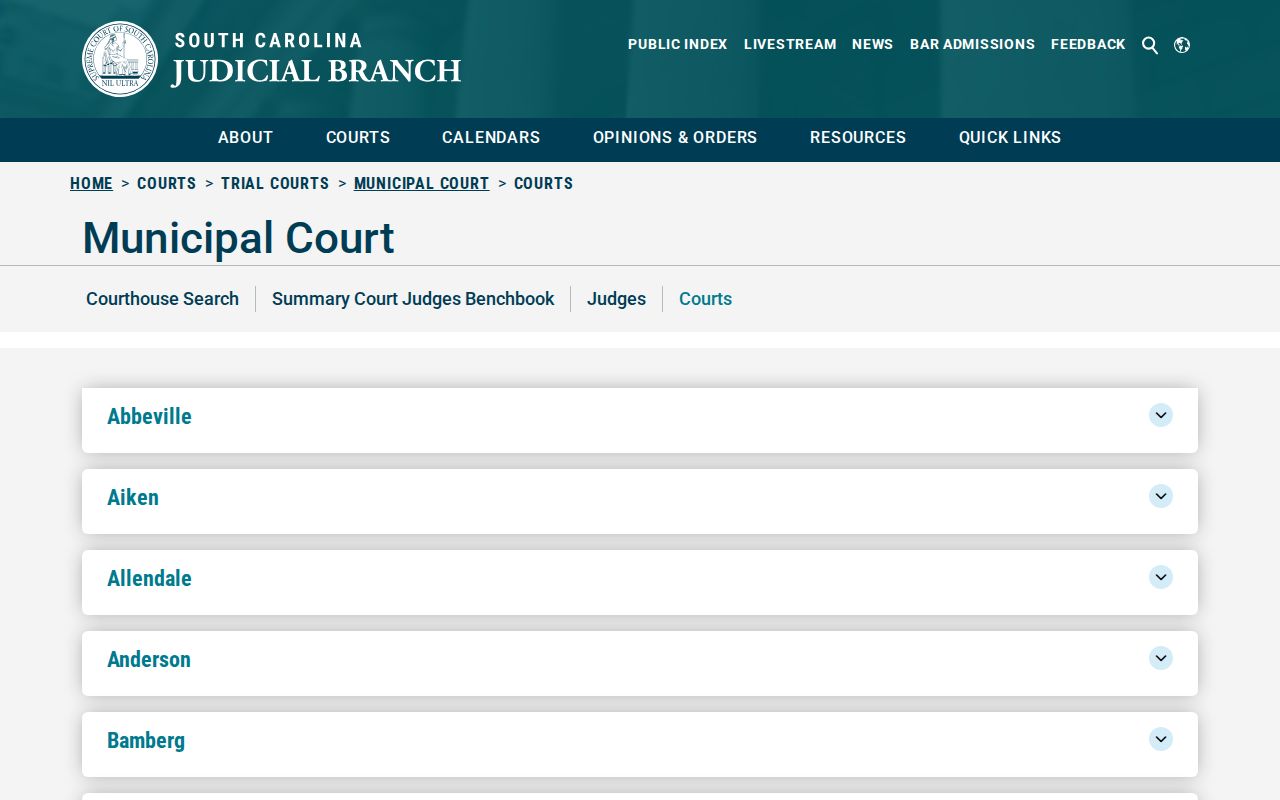
That directory helps route a Saluda County summary case without implying that every small municipal court offers online records.
Stages of a Criminal Case
A custodial case may start with booking and an initial appearance before a prosecutor settles on the filed charge. General Sessions cases can then proceed through a warrant or complaint, indictment, arraignment, roster placement, motions, hearings, plea or trial, disposition, sentence, and post-judgment activity. A citation may begin directly in a summary court. No single timetable fits every Saluda County criminal case, so the docket should be read as a sequence rather than judged by one isolated event.
Case flow: Charges Filed › Arraignment › Pretrial › Plea or Trial › Disposition › Sentencing
The booking charge, indictment charge, and conviction offense can differ. That is normal record evolution, not proof that one custodian made an error. Compare each count with its final disposition. For a wider account of the initial custody layer, the county's arrest history channels explain how agency and detention records precede the court file.
The Eleventh Circuit Solicitor prosecutes General Sessions matters for Saluda County and three other circuit counties. Its charging decision helps explain why the offense on an indictment may differ from the booking label. The solicitor also administers diversion programs and is the starting office for many eligible General Sessions expungement requests, but the Clerk of Court remains the custodian of the filed docket.
Read Saluda County Case Outcomes
Status words need context. Pending or open means the allegation remains unresolved. Guilty, convicted, or plea indicates an adjudication, but the sentence and exact offense still matter. Dismissed and nolle prosequi mean the prosecution ended on that count without a conviction. Not guilty or acquitted means no conviction on the tried count. Transferred, remanded, or appealed directs the reader to another record and is not a final decision on the merits by itself.
- Nolle prosequi
- A prosecutor's formal decision not to continue that count.
- Disposition
- The recorded outcome for a charge, which must be checked count by count.
- Remanded
- A matter sent to another court or level for further action.
- Expungement
- A legal process that can restrict eligible records after an order reaches the custodians.
A dismissal or acquittal does not guarantee that every arrest reference vanished. Eligible General Sessions matters generally begin with the Eleventh Circuit Solicitor, while qualifying dismissed summary charges are handled by the summary court. Obtain the source disposition before asking SLED to correct or confirm a state history.
Saluda County Federal Case Layer
Federal prosecutions involving Saluda County are not stored in the county Public Index. They belong to the U.S. District Court for the District of South Carolina, with dockets and documents available through official PACER access after registration. A federal file should not be confused with a General Sessions record merely because the underlying event occurred in the county.
The District of South Carolina site identifies the federal court layer.
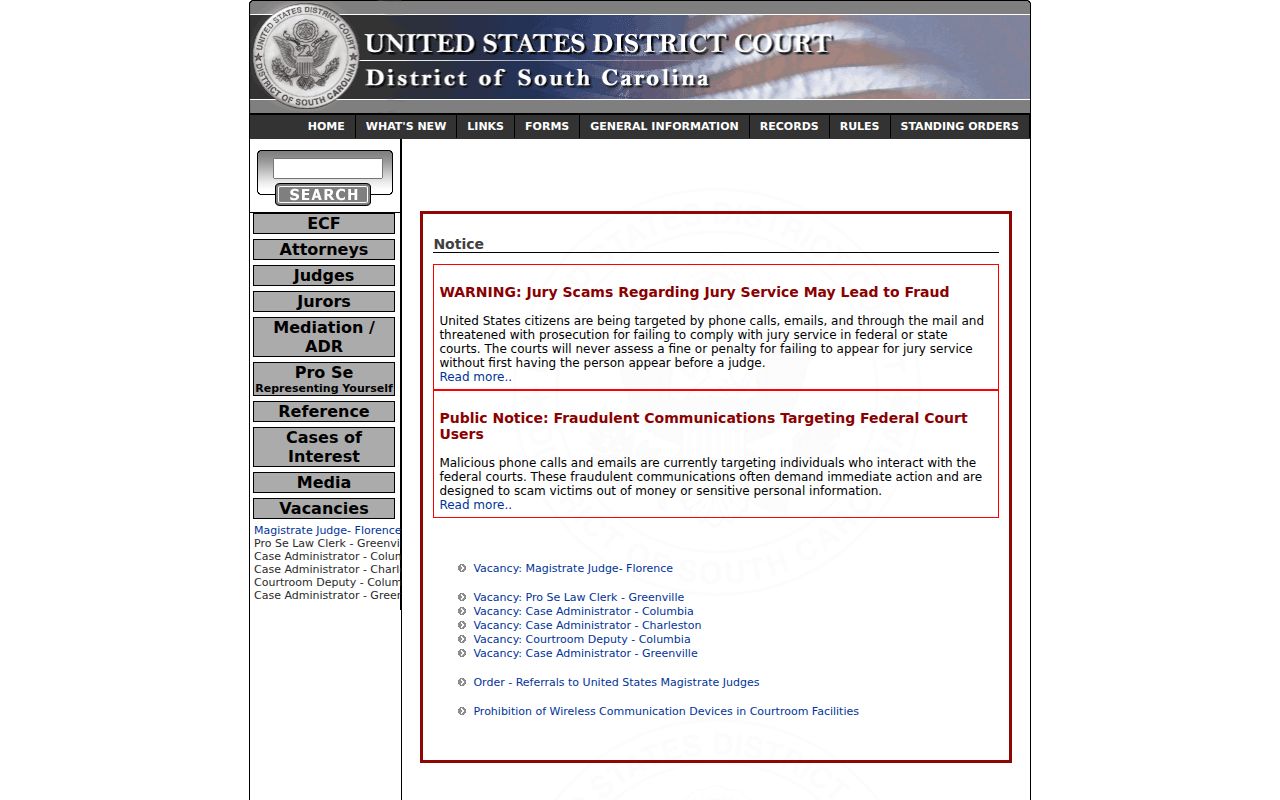
This separate court source closes a gap that neither the Saluda County clerk nor the state Public Index can fill.
Access & Restrictions
South Carolina court access is broad but not absolute. Juvenile material, sealed or expunged cases, protected identifiers, victim-sensitive details, and records covered by a court order may be absent or redacted. Public Index also may list a docket event without exposing its document image. An online miss does not prove that no case or proceeding exists. Ask the proper clerk to search the case number, spelling variants, and older paper holdings.
The clerk can explain access and copy procedure but cannot provide legal advice. For an apparent error, save the docket details, obtain the filed disposition, and direct the correction to the office that created the entry. South Carolina Law Enforcement Division criminal history is a different repository product, so fixing the court source and fixing a SLED entry can require separate contact.